by Giulia Penta
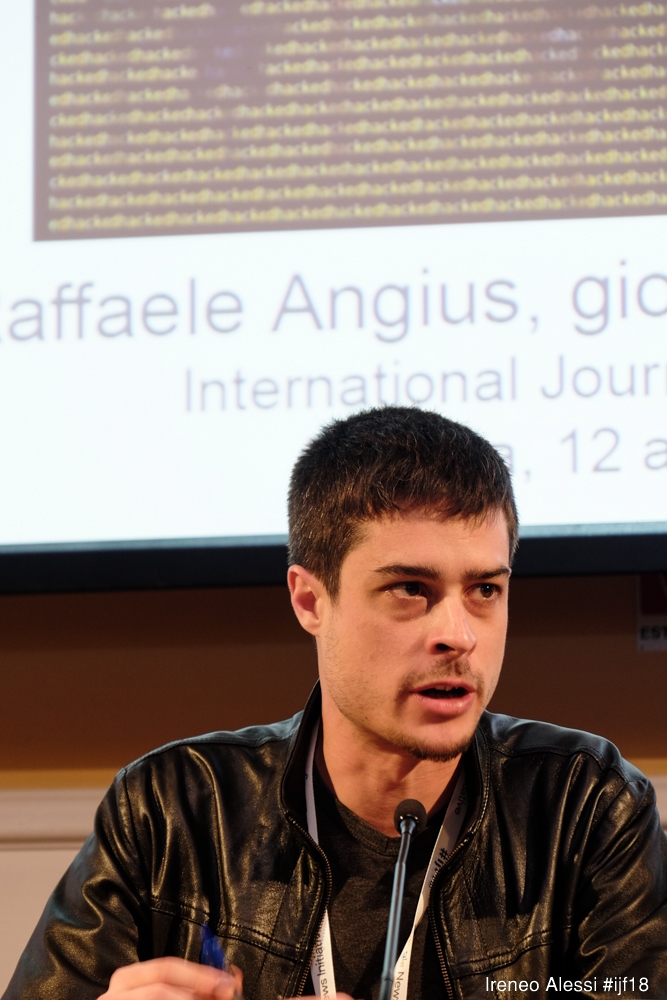
Rarely without a guitar in one hand and a computer in the other, Raffaele Angius has been drifting for years, seeking new contexts of community resistance to immerse himself in and learn from. ‘Leaving one’s homeland should be required by law. For us islanders, the motivation also comes from wanting to escape a rock in the middle of the sea’. A life led with a backpack never unpacked.
For ten years, he has been reporting on news stories involving the world of technology, but it doesn’t get any easier. As the Italian government and intelligence services are in the quicksand for the controversy surrounding the Paragon’s Graphite case, Angius is on it. ‘I am trying to find an access channel, but it’s proving to be quite an undertaking even for my sources’.
Before becoming the journalist who managed to breach the Rousseau platform to demonstrate its vulnerabilities, and to have in hand, before anyone else, the details of the story of the Italian Ministry of Justice hacker Carmelo Miano, Angius spent his adolescence among anti-fascist and self-affirmation movements.
His background led him to settle in Palestine in his twenties, where he collaborated with the Alternative Information Centre (AIC), and performed a Kenze Neke’s song with an Arab band of ten in front of 3,000 people on Nakba Day, in Bethlehem.
Within the frame of the webcam, a poster of Open Shuhada Street, the movement for reopening the road in Hebron, catches the eye. He went to Palestine on his own, saving up doing odd jobs, from janitor to organising cultural events, but his family helped him greatly: ‘I believe that this is the greatest hypocrisy that journalists in Italy never talk about. Being a journalist costs a fortune, and it drives me up the wall: they all pretend to have come out from under a bridge, but there’s nothing more bourgeois than pretending to be poor’. He thinks of his time at La Stampa, ‘I did many well-crafted, valuable works, and I did them for free, 18 hours a day. When they hired me, they didn’t have the funds to let me keep up the same quality I could working for free’.
• Born in Cagliari in 1988, he holds a bachelor's degree in Political Science. In 2014, he wrote his thesis on the Palestinian scout movement while also reporting for Nena News.

• In 2016, he obtains a master’s degree in International Cooperation and Human Rights Protection in the Mediterranean and Eurasia.

• After graduating, he joined the investigative news outlet L'Espresso in Rome. He developed RegeniLeaks, a platform to collect information on the murder of Italian researcher Giulio Regeni.

• Between 2016 and 2018, he attended the "Giorgio Bocca" Journalism School in Turin, which landed him a contract at Agi news agency.

• In 2021, he launched Indip, an investigative newspaper based in Sardinia. Today, he is Senior Reporter and Editor for IrpiMedia, the independent publication of Investigative Reporting Project Italy (IRPI).
While it weighs heavily on him that he didn’t grow professionally in Sardinia, he is still abuzz after the recent cross-border investigation on the Russian shadow fleet came out. Led by Follow The Money, he was involved in it with IrpiMedia. And it still touches a raw nerve.
Pausing for a few seconds on a Cyrillic poster of Pink Floyd’s 1989 live performance in Moscow, he tells me about the challenges of working on transnational investigations.
‘The premises in this type of project are typically wrong’ he says. ‘You can’t call it a Russian fleet until you find Russians behind the ownership of the ships, which none of us did. That’s propaganda’. He calls out a certain European rhetoric that, almost wearing blinkers, must identify a villain. ‘If you read our piece and those of other partners, it emerges that we wrote something fundamentally different’.
The problem in this case, he specifies, was not so much disagreeing on the facts, but rather the timing. Other countries were already far ahead in drafting their stories. There was no time to reimagine the structure. ‘I am happy with the intellectual process that took place. We did a gigantic somersault, we managed to write a piece of service that was less sensational than the others, but more accurate’.
‘So’, he comments, ‘this is a bit of the limit of these international collaborations that are very much based on a single source of data, a single point of view, on a single target. You can’t work by theorems.’
Today, he invests in what he believes to be the heart of useful journalism: ‘local journalism is the most effective, even if it means taking a step back. Being a journalist isn’t about being great or small; it’s about delivering valuable news to the community. Not every story needs to be a large-scale international investigation. If you treat every story as if it were the most important story of your life, people will remember them’.