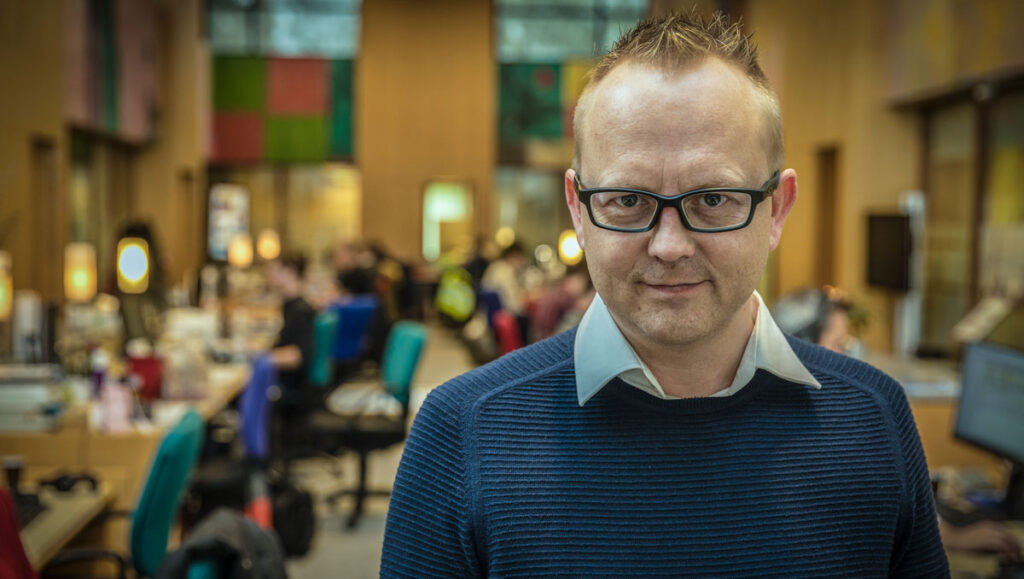
Written by Merel GeldersIn the shadowy world of espionage, financial fraud, and high-stakes corruption, Belgian investigative journalist Kristof Clerix (47) has made a career out of uncovering secrets that some would rather keep buried.
Kristof Clerix has reported from more than 40 countries, covering terrorism, human and drug trafficking, illegal arms deals, financial fraud and more. For the last ten years, he has worked for the Belgian news magazine Knack.
About Kristof Clerix
- Journalist since 2002
- Specializes in security reporting and long-term investigative projects
- Wrote two books about espionage in Brussels
- Worked on: Lux Leaks, Panama Papers, Pegasus Project, Qatargate, …
- Won several national and international awards
Straight out of a movie
Friday, the 9th of December 2022. “It was absolutely crazy,” Clerix recalls. “That morning, house searches had just begun when Eva Kaili’s father was caught with a suitcase containing €150.000 in a hotel in Brussels.” Qatargate, an investigation that Clerix worked on, rocked the European Parliament, revealing bribery schemes involving Qatari officials.
“It was like a scene straight out of a movie – and we broke the story.”
Another project in Clerix’ repertoire is a collaboration with the International Consortium of Investigative Journalists (ICIJ), the Panama Papers – a historic collaboration that exposed how politicians, celebrities, and criminals hid billions in offshore accounts. “Without a doubt, one of the most incredible investigative projects I’ve ever been part of”, Clerix says.
Joining the ICIJ was a game-changer. “The world literally opened up,” Clerix explains. International collaboration is essential in investigative journalism according to him. “The issues we investigate – financial fraud, drug trafficking, corruption – are global. The world doesn’t stop at national borders.”
“Criminals, spies, and law enforcement agencies work together across borders, so it only makes sense for journalists to do the same.”
The risks of exposing the truth
While Clerix has never faced physical threats, legal threats are another matter. “People try to sue me over publications,” he says. “One person even demanded five million euros if we did not retract an article.”
Other investigative journalists have had to pay the ultimate price. Clerix remembers Daphne Caruana Galizia and Ján Kuciak, two of his colleagues involved in the Panama Papers investigation who were later murdered.
“This profession comes with risks, and with the murder of Dutch journalist Peter R. de Vries, we know that danger can strike close to home”, Clerix says. “These are realities that we must always be aware of.”
The formula for a great investigator
So what does it take to be a great investigative journalist? Clerix boils it down to two things: persistence and accuracy. “Keep going, keep searching, even if the door has been slammed in your face nine times, you still try the tenth time,” he says. “If you truly want to uncover something, you have to persist.”
The second key trait is meticulousness. “Check, double-check, and triple-check. More than in any other form of journalism, investigative reporting must be accurate. We frequently challenge the powerful, people who can afford top-tier law firms that will scrutinize every letter and comma. As an investigative journalist, you simply can’t afford to make mistakes.”
“You only have one reputation, and it’s everything. It takes years to build, but one mistake can wipe it all away. There’s a lot of responsibility on your shoulders.”
Advice for aspiring investigators
For those looking to follow in his footsteps, Clerix has some advice: “Specialize in a topic, write a book, apply for grants, do internships, attend journalism conferences, start a blog, and stay up to date with AI and search technologies.”
“Keep your eyes and ears open – you never know where your next big story will come from.”