
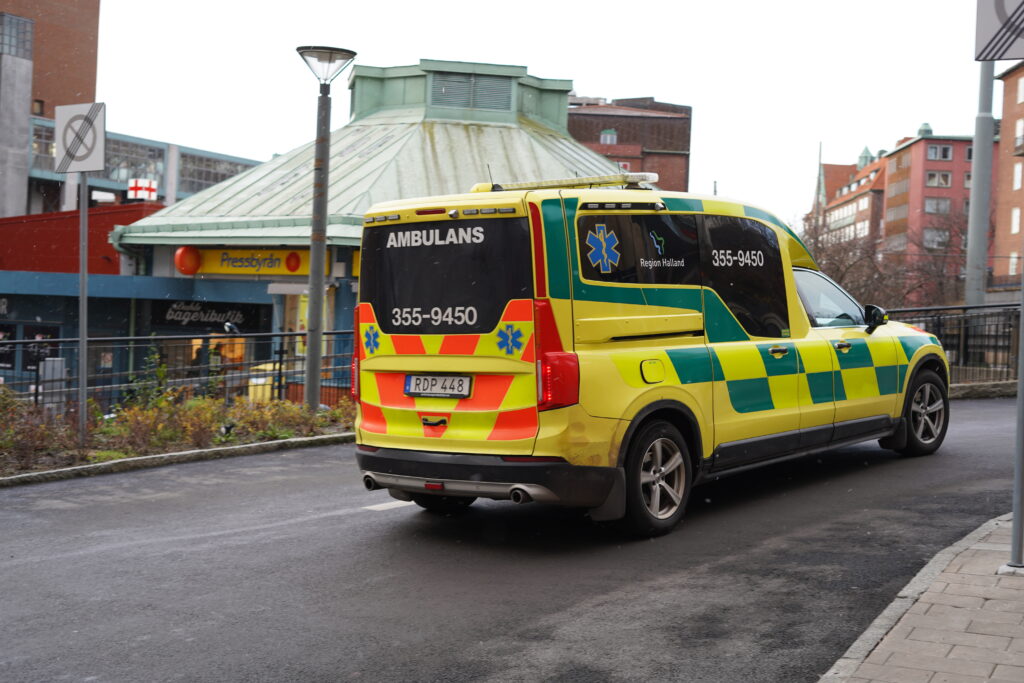
“Completely Unacceptable”: Ambulance Response Times on the Rise in Västra Götaland
By Camilla Wasén January 16, 2025
NEWS • Every second counts in an emergency, but in Västra Götaland, patients are waiting longer than ever for ambulances to arrive. New data reveals response times in the region are slower than the national median. “It shouldn’t take them that long,” says an emergency nurse at Östra Hospital in Gothenburg.
In 2024, ambulances in Sweden responded to life-threatening emergencies, or “Priority one cases,” within a national median time of 15 minutes, according to SOS Alarm. Meanwhile, the wait for ambulances in Västra Götaland was 16 minutes and 18 seconds.
Compared to Sweden’s two other largest regions, Västra Götaland trailed behind both Skåne’s 14 minutes and 54 seconds and Stockholm’s 14 minutes and 24 seconds.
Every minute counts
A few minutes might not sound severe, but delayed care can mean the difference between life and death in an emergency. “Especially if it’s a cardiac arrest – one extra minute can lead to serious brain damage or the person dying,” Matilda Liljegren, an emergency room nurse at Östra Sjukhuset in Gothenburg, says.
Medical studies support this link between ambulance response times and health outcomes. Out-of-hospital cardiac arrest patients were 24 percent more likely to survive if paramedics arrived just one minute sooner, states a recent study from the UK.
Response times on the rise
Despite the life-saving potential of faster emergency care, Västra Götaland gets further from its target of a 12-minute response time with every passing year.
The region’s own data paints a picture of a system that struggles to keep pace: the number of priority-one cases in Västra Götaland rose by 15 percent between 2013 and 2023, while the median response time increased by more than 31 percent. This increase leaves people in potentially life-threatening situations waiting nearly 4 minutes longer for help.
“It’s completely unacceptable,” Matilda Liljegren says, remembering that one ambulance took 15 minutes to fetch a man suffering a stroke for transport from Östra to Sahlgrenska Hospital. “It shouldn’t take them that long to fetch a patient who is already at the hospital.”
Staff shortages
The challenges facing Västra Götaland’s ambulance services are manifold but staffing is the most pressing systemic issue, says Moez Dharsani, Member of the Regional Healthcare Board in Västra Götaland and Political Secretary for the Social Democrats. “It is primarily a skills supply issue,” he explains. “The situation is quite serious.”
Västra Götaland’s struggle reflects a nationwide trend. A 2023 survey from Socialstyrelsen shows that only 43 percent of ambulance staff have specialist training, and up to 70 percent of regions anticipate a poor long-term supply of skilled professionals.
Gaps in training, recruiting, and retention
The region’s workforce puzzle starts with education. “There aren’t enough training sports,” says Moez Dharsani. “And those who actually graduate are difficult to recruit,” he continues, noting the competition from other regions. “They can just as easily move to Halland.”
Getting workers to stay poses the next challenge. “If you don’t look after them, they leave – you’ve lost them,” he adds. Despite the region’s efforts to improve retention through competitive salaries, progress is uneven. “Some occupational groups are below the national average.”

Ambulances spared, but cuts affect emergency services
While funding plays a part in workforce challenges, Moez Dharsani is adamant that ambulance delays cannot be traced back to budget cuts.
“We have been in the most serious situation ever in the history of the region in terms of money,” he acknowledges, referring to inflation and government cuts. “But every time there is talk of cutting ambulances, it is a no from the politicians. It’s not on the agenda.”
Ambulances may have been spared, but economic pressures are affecting healthcare across the board. In the past year, Sahlgrenska University Hospital faced Sweden’s largest reductions, having to cut 1.7 billion SEK by the end of 2024, reports SVT News.
Ambulance misuse worsens delays
Difficulties to correctly assess case urgency is another factor slowing down ambulance response times. In 29 percent of cases, ambulances in Västra Götaland never collect the patients they reach, according to Socialstyrelsen. These unnecessary dispatches tie up resources and make it difficult to reach critical patients quickly.
Moez Dharsani notes that many residents are unaware of care options for less urgent situations. For rural residents, however, ambulances may be their only link to care. “If you don’t have a hospital or health centre that’s open or on call, you have nothing without the ambulance,” Moez Dharsani stresses.
Not all areas are equal
Yet, in many rural areas, timely ambulances are even harder to come by. For instance, Essunga municipality endured a median wait of approximately 26 minutes in 2023, compared to 12 minutes and 19 seconds in Lidköping. This 17-minute difference shows the depth of emergency care inequalities across Västra Götaland.
Regional restructuring may soon repaint the regional response-time map. In 2024, an emergency room in Skövde opened, and one in Lidköping closed. Just two months after their doors shut, a Läkartidningen article told of a cardiac arrest patient being left waiting for transfer to another hospital – for 30 minutes.