By Nigar Hasanova
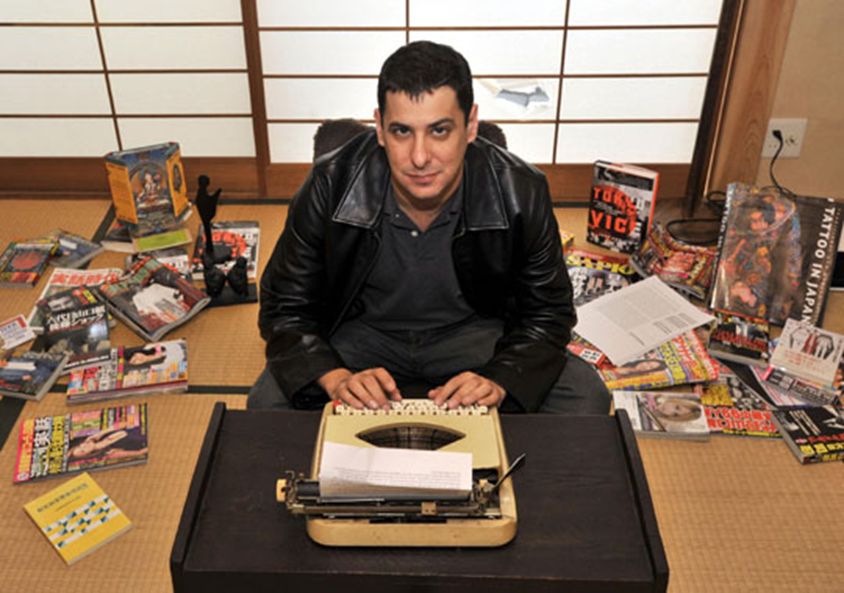
“Locals have always been skeptical, even when I took the exam for Yomiuri Shimbun, that I, a foreigner, or in their term, gaijin, would be able to pass the exam for one of the Japanese newspapers having the highest daily newspaper circulation in the world,” says Jake Adelstein, reflecting on the beginning of his career in Japan.
As the first non-Japanese reporter at Yomiuri Shimbun, Jake Adelstein, an American journalist currently based in Japan, is known for his investigations into yakuza, Japan’s mafia. Despite his quirky and flamboyant personality — often spotted wearing colourful patterned T-shirts — the topics of his investigations are completely opposite.
Gaijin who knows too much
His most notable work is about Goto Tadamasa, a crime boss who made a deal with the FBI to gain entry to the United States for a liver transplant at the University of California Los Angeles (UCLA). The aftermath of this exposé led to numerous threats against his life and the need for police protection. He remains an active journalist working in the industry and the author of Tokyo Vice, a memoir depicting details of his investigations.
During these years, Jake Adelstein has been accused of exaggerating his stories. After publishing an exposé on Tadamasa Goto, critiques appeared in Hollywood Reporter, Esquire, and Le Soir, describing his stories “far-fetched,” or “fiction.” When asked about allegations, Jake responds: “If my work were fiction, I wouldn’t have had my life threatened, my home watched, or my family advised to leave the country.” Indeed, Tadamasa Goto published his autobiography, hinting at him as an “unpleasant journalist.” The danger seemed real as Goto mentioned in his autobiography:
“If I did meet him, it would be a serious matter. He’d have to write; Goto is after me instead of Goto may come after me.”
On starting in a totally different culture or moving to another country for a career, he highlighted the importance of not falling under the “delusion” that people will accept foreign journalists completely, “Yes, you will have people around you, and as you learn culture and language, they will forget that you are a foreigner, but outside of that community, regardless of how knowledgeable you are, you will always remain a gaijin.”
Investigative Journalism 101: Lessons from Jake Adelstein
The main principle he follows is: “Enemy of my enemy is my friend.” Finding the opposition makes it easier for you to find the leads through them. Networking is important and relationships are built on reciprocity — or in his term giri, “If you do give something to them, they’ll also pay you back.”
He also emphasizes the power choosing your stories: “Just because the information could be an interesting story, doesn’t mean you have to write it. As journalists, you have the freedom to pick your story.”
As advice to investigative journalists, he says, “Most new journalists think if source gives you information journalists owe them, but it’s the total opposite – they owe you. No one gives that information out if there isn’t something in it for them; they are not giving it out of the goodness of their heart. Setting boundaries before publication is beneficial for journalists. If they think you owe them, then they can find another person.”
Jake underlines the value of asking the correct questions. According to him, the most important question is “Was the information I received true? Knowing the motivation behind truthful information is not always my business. If it’s truthful, their motives are clearly self-serving.”
Yet there is one lingering question that most people think when they hear Jake Adelstein’s name: Did he experience all the dangers that he describes in Tokyo Vice or is his imagination also vivid like his personality? Perhaps only he knows the full truth—and that, in itself, may be his greatest story yet.
Table of Facts:
| He was born in 1969 in Missouri, USA. |
| He moved to Japan for an exchange program in Japanese literature at Sophia University in Tokyo and settled down there. |
| Adelstein was subsequently a reporter for a United States Department of State investigation into human trafficking in Japan and now writes for the Daily Beast, Vice News, The Japan Times, and other publications. |
| Adelstein is an author for Tokyo Vice, Tokyo Noir, The Last Yakuza, and I Sold My Soul for Bitcoins, focusing on organised crime and cybercrime. HBO’s Tokyo Vice (2022)—a drama series—is loosely based on his book Tokyo Vice, though he has stated that parts of the show are fictionalised. |